Cutting AI subscription spend without cutting the tools
Annual billing, one card for every tool, and paying over three months at 0% APR: the three levers that actually move an AI budget, and the arithmetic behind each one.
9 min read Mattia Ciuni
Most teams do not overspend on AI because they bought the wrong tools. They overspend because of how they pay for the right ones: monthly billing at retail, one card per tool, every charge landing in the same week. The tools stay, the subscriptions stay, and the bill keeps growing.
There are three levers that move an AI budget without removing anything from the stack, and they stack on top of each other: the billing period, the number of payment methods, and the payment terms. Below is what each one is worth, with the arithmetic, and how to tell whether it applies to you.
The shape of an AI bill
Every line has a cheaper annual plan
An AI subscription bill is a stack of small monthly charges, and almost every line on it has an annual plan that costs less per month than the monthly plan does. That is not a discount gimmick: annual billing gives the vendor your money a year ahead of time, and it gives them a customer who will not churn in March. Both of those things are worth something, and the vendor pays for them with a lower monthly rate.
Why the cheaper price goes unclaimed
The reason most people do not take it is cash flow, not price. Paying $20 a month is easy; paying $200 today for the same twelve months is a decision, and it lands in one week along with every other annual renewal. So the annual price stays on the table, unclaimed, and the stack pays monthly retail for years.
Everything below is about removing that cash-flow reason without pretending the price is lower than it is.
What a year of a stack looks like
Numbers make the shape of the problem obvious. A five-tool stack at $20 a month each is sixty charges a year on monthly billing, spread across twelve statements, and $1,200 leaving the account. The same five tools on annual plans are five charges a year, roughly $1,000, and all five land in the same week – usually the week the tool was first signed up in.
So the choice is not between a small amount and a big one: it is between sixty small decisions you never make and five big ones you cannot avoid. Neither of those is comfortable, which is exactly why the third option – the annual price, paid in installments – is the one worth looking at.
Lever one: the billing period
One tool
Take a single tool at $20 per month. Monthly billing costs $240 a year. The annual plan on the same tool is usually around $200, which is $16.67 a month for the identical product: about 17% less, for one decision a year instead of twelve payments.
A real stack
Now multiply that by a real stack. Five tools at $20 per month is $1,200 a year on monthly billing and roughly $1,000 on annual plans, before anything else. The saving is not dramatic per tool, which is exactly why it goes unclaimed: nobody switches a subscription to annual to save $40.
The higher tiers
Where it becomes a real number is at the higher tiers. A $100 per month plan is $1,200 a year monthly against roughly $900 annual, and a team with a handful of seats is looking at four figures of difference for the same usage.
The two prices, and the break-even
- Monthly billing: the flexible price, and the most expensive way to buy a tool you already know you will keep.
- Annual billing: the same product, roughly 15-20% cheaper per month, paid in one charge.
- The break-even almost always lands between the tenth and the eleventh month: if you expect to use the tool next year too, the annual plan is already cheaper when you sign up.
Lever two: one card instead of eight
What many cards hide
The second lever is not about price at all: it is about how many places your AI spending lives. When every tool has its own card, a renewal you forgot about looks exactly like a renewal you approved, and the person who notices is the one reading the statement at the end of the month.
What one card makes visible
One card for the stack changes what you can see. Every AI charge is on one statement, in one place, sorted by billing cycle, and the tools you stopped using show up as lines you can point at instead of charges buried in a personal card. Most teams that go through this exercise find one or two subscriptions nobody remembers buying.
It also removes the month-end reconstruction: no matching a vendor name to a person to a project to explain a charge. The statement is the answer.
The three things that change
- One statement per billing cycle, with every AI tool on it.
- Renewals you did not plan become visible before they repeat.
- Cancellations are one decision away, because you can see what you are paying for.
The audit that pays for itself
A single pass through the statement takes an afternoon, and it is the only AI spending work that compounds: every charge it removes would otherwise have repeated twelve more times. Three questions do almost all of the work:
- Which tools have I actually used in the last thirty days? Everything else is a cancellation, not a cheaper plan.
- Which of the ones I kept are still on monthly billing? Those are the annual plans, and the discount is already on the table.
- Which of them are charged to a personal card, or to a card nobody else can see? Those are the charges that never get reviewed at all.
What the audit leaves behind
On a five-tool stack the pass usually ends in two or three changes, and the money it frees is larger than the discount on any single subscription – because two of those changes are usually cancellations. What it leaves behind is not a saving, it is a list: the tools you keep, the price you will pay for each one, and the date the next decision is due. That list is what makes the next quarter an afternoon instead of a reconstruction.
For a team, the same pass becomes a question about who owns each charge: the enterprise page covers how shared limits and seats work when more than one person is spending on the same card.
Lever three: how you pay, not how much
The question changes
The third lever is the one the first two unlock: if the annual plan is the cheaper price and the obstacle is paying for twelve months at once, then the question is not whether to switch to annual, but how to spread the annual charge.
Where the card sits
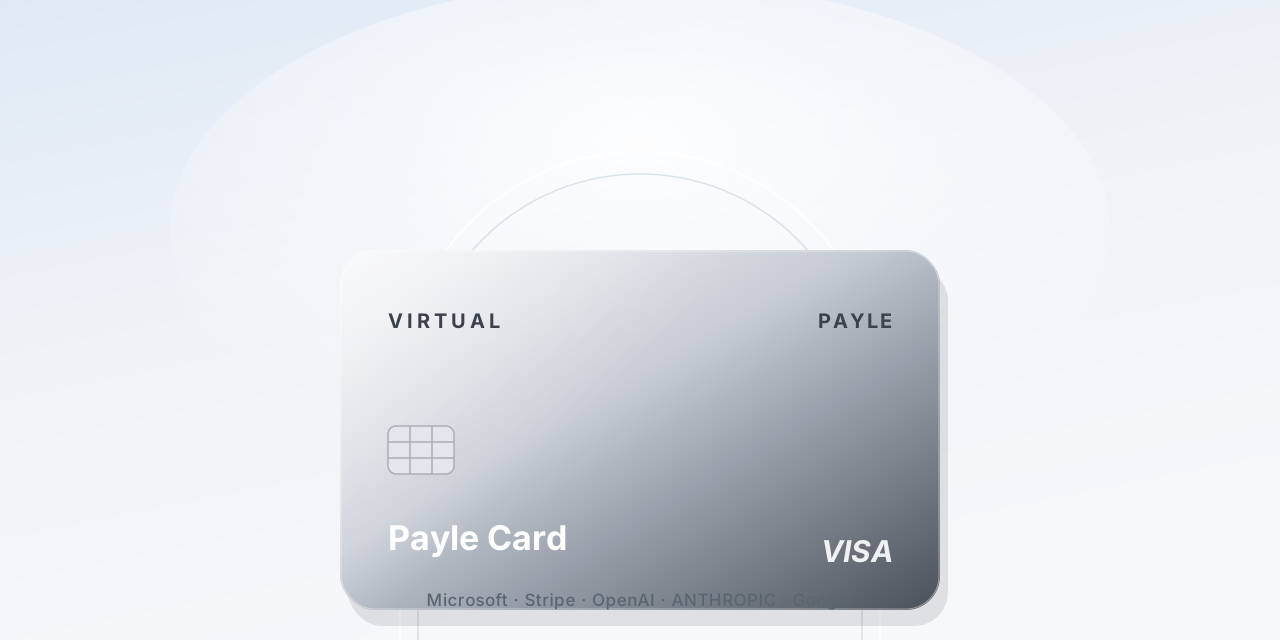
This is where the Payle Card sits. Approved AI purchases are split into three monthly installments at 0% APR with no fees: you pay nothing today, and the balance is divided across the next two months. Longer terms exist for larger commitments, 6 and 12 months at a fixed 17.60% APR with no monthly fee and no prepayment penalty.
Price and terms are two different things
The two things stack, and they are not the same thing. The annual plan is the price. The installments are the terms. Used together, an annual plan at roughly 25% below retail, spread over three months at 0% interest, comes out below the monthly retail price for the same tool, with no interest to pay for the privilege.
What the terms do not cover
The terms are about when you pay, and on their own they do not make anything cheaper. Two things they do not do, and it is worth saying both plainly. An approved purchase has to be an approved tool: the allowlist is enforced at the network level, so a charge from a merchant outside it is simply declined – and that same network is what keeps the card out of places that have nothing to do with AI. And a split does not erase the balance, it moves it: the installments are equal, and the full amount is paid inside the window.
Approval uses a soft credit check, so asking does not leave a mark on your file. The cases where a hard check applies – a higher limit, the Plus plan, some jurisdictions – are set out in the FAQ, together with what happens after the third month.
What it looks like on one subscription
The baseline
A $20 per month tool, bought the way most people buy it: $240 a year, twelve charges, monthly retail, ending whenever you stop. That is the baseline.
The same tool, on the card
The same tool as an annual plan at the Payle price, paid in three installments at 0% APR: about $180 for the year, which is roughly $15 a month, and no interest on the split. The difference is about $60 a year on a single subscription, and the monthly figure is lower than the monthly plan you would have been on.
That is one tool. The point of the exercise is not the $60: it is that the same arithmetic holds for every line in the stack, and the stack is where the budget actually lives.
When not to switch
The bet you are making
Annual billing is a bet that you will use the tool. Sometimes that bet is wrong, and it is worth saying so plainly, because a guide that only counts the wins is an advertisement.
When to stay monthly
If you are still deciding between two tools, stay monthly until you have decided: the annual discount on a tool you abandon in month three is a loss, not a saving. If your usage is dropping month over month, that is a signal to keep the flexibility, not to lock in a year.
The honest test
For the higher tiers the honest test is the same one you would apply to any annual commitment: how many months of the year will you actually use it? For most teams, a tool that has already survived a quarter of daily use survives a year.
The checklist
If you want the short version, this is the order that matters. Run it once a quarter; it takes an afternoon and it is the only AI spending work that compounds. Keep what it produces – the tools you keep, the price of each, the date of the next review – because those three lines are what the next quarter starts from instead of another reconstruction.
The order that matters
- List every AI tool you pay for, with its monthly price and who uses it.
- Mark the ones you have used in the last thirty days. Everything else is a candidate for cancellation, not for a cheaper plan.
- For the ones that remain, compare the monthly price with the annual price per month.
- Pick the annual plan for the tools you expect to keep, and move them onto one payment method.
- Split the annual charges over the terms that keep the monthly payment below the monthly retail price.
- Put a reminder in the calendar for the renewal dates, so the next decision is a decision and not a surprise.
What to do next
The financial layer
The Payle Card is the financial layer under this exercise: one card for Claude, ChatGPT, Cursor, GitHub Copilot and the rest of the catalog, with approved annual plans at roughly 25% below retail and purchases split over three monthly installments at 0% APR.
Applications and the first 1,000 cards
Applications are separate from the waitlist, and the first 1,000 cards are the early-access cohort: priority processing, and features as they ship rather than on a delayed rollout. Approval uses a soft credit check, which means asking does not leave a mark on your file.
Frequently asked questions
- On the same tool, yes, and by two mechanisms that add up: the annual plan costs less per month than the monthly plan, and splitting the annual charge over three months at 0% APR keeps the monthly payment below monthly retail without paying interest for it. What changes with the card is when you pay, not what you pay in interest. The two mechanisms are independent – a plan discount is a price, an installment plan is a date – which is why they stack instead of replacing each other.
- The balance is paid off inside the three-installment window. If you would rather spread a larger commitment further, 6 and 12 month terms are available at a fixed 17.60% APR with no monthly fee, and there is no prepayment penalty if you clear the balance early. Nothing rolls over into a fourth month, and paying early does not cost anything extra.
- Yes. Add the card as the payment method in the tool’s billing settings and the next cycle charges to it. There is no need to cancel and start over, and no second account to maintain: the card is an additional payment method on the account you already have, not a replacement for it.
- The Payle catalog of approved AI and software tools, including Claude, ChatGPT, Cursor, GitHub Copilot, Perplexity and the API usage from those providers. The allowlist is enforced at the network level, which is also what keeps the card out of merchants that have nothing to do with AI. Usage-based billing from those providers flows through the same terms as a subscription.
- Initial approval uses a soft credit check, which does not affect your score. A hard check may apply for higher limits or the Plus plan, depending on your location and credit profile, and it is always disclosed before it happens. The limit on the card, not the check, is what changes with the plan you pick.